The 1% Differences Making Mercedes Unstoppable in 2026
Mercedes has locked up back-to-back 1-2 finishes at Australia and China, and the rest of the paddock is starting to look just a teensy nervous. A breakdown of the three engineering advantages — compression-ratio thermal trickery, real-time energy strategy from HQ, and electric drive efficiency — driving the early-season dominance.

01Welcome
Welcome to Overtakers — I'm Sean Gleason, a proud supporter of #IWorkForGM.
A quick word on Cadillac
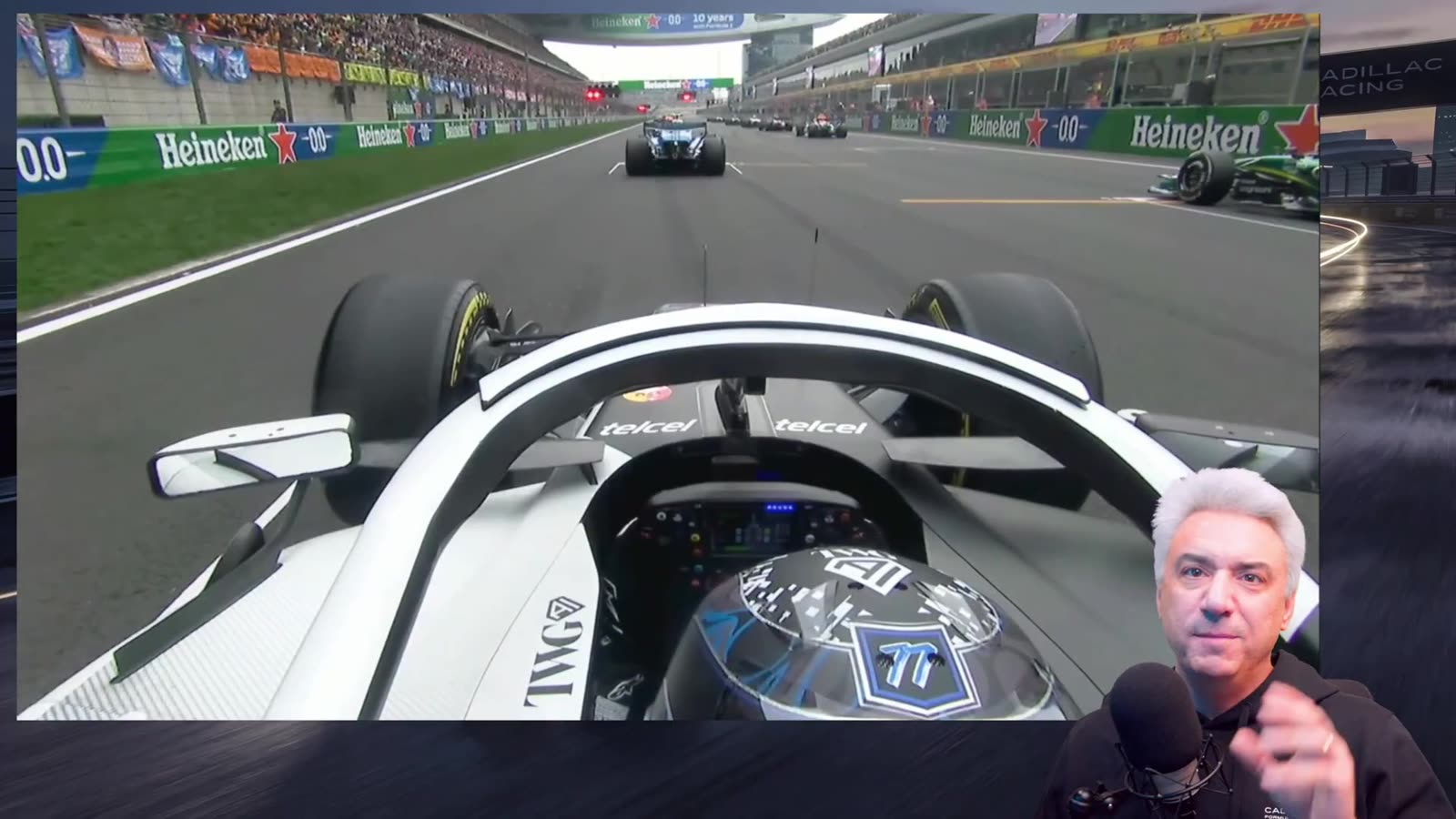
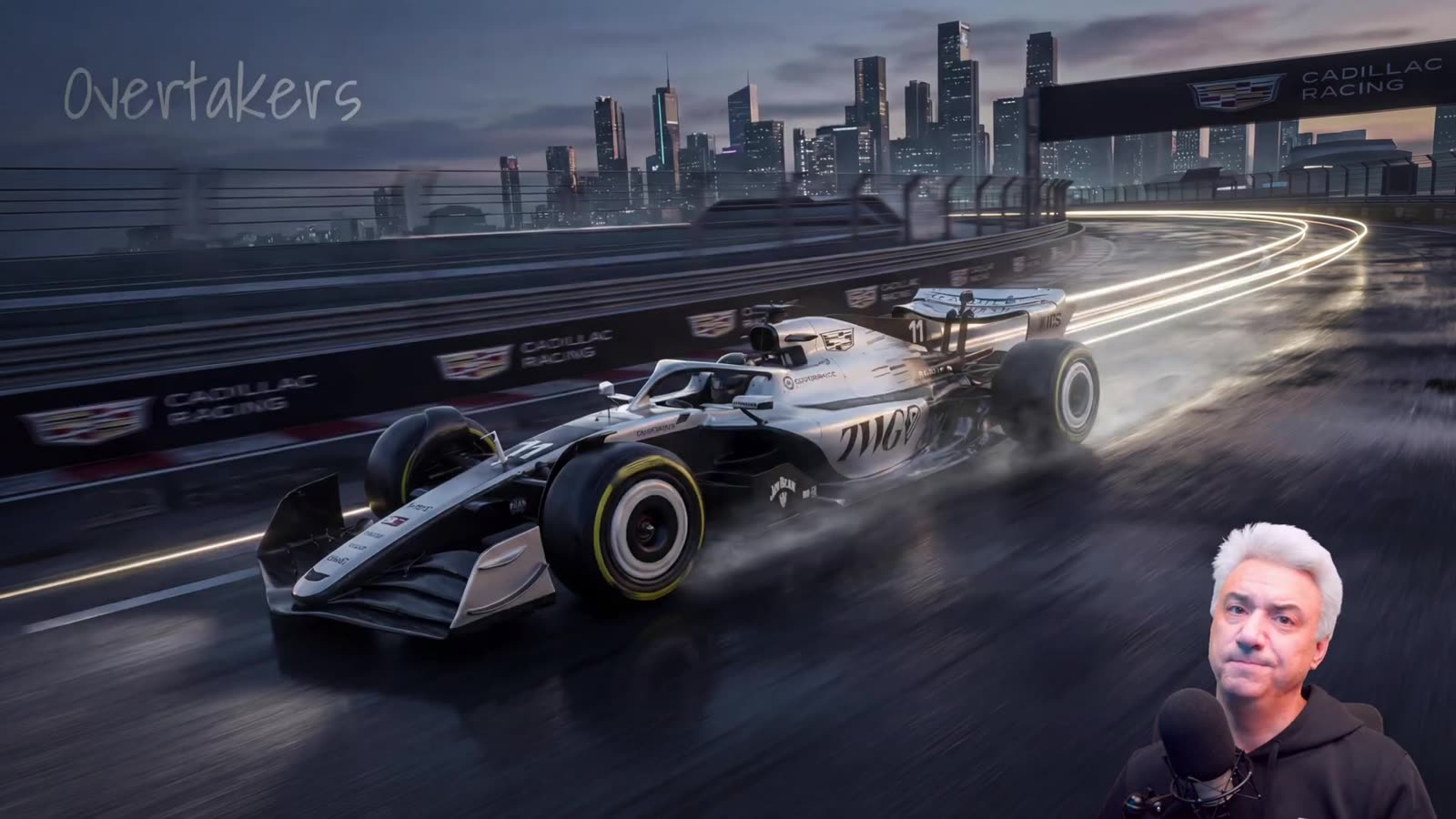
Before we get into today's main story, a quick but well-deserved shoutout to the Cadillac F1 team. Coming out of China, both cars finished when seven other cars didn't complete the race. For a team in their very first season, that is a serious statement and very impressive. Keep pushing those upgrades, and I genuinely cannot wait to watch them race in Japan. Rock on, Team Cadillac.
02Now — To The Main Event
Mercedes has locked up back-to-back 1-2 finishes at both Australia and China, and the rest of the paddock is starting to look just a teensy nervous.
So what are they doing differently? Today we are going to break down the three engineering advantages I think are driving their early dominance — and trust me, the engineering here is genuinely fascinating.


This calls for an Engineering Investigation.
03Advantage 1 — The Compression-Ratio Trick
Mercedes is rumored to be exploiting a brilliantly clever mechanical design that takes full advantage of how the 2026 F1 regulations are worded.
First — what is compression ratio?
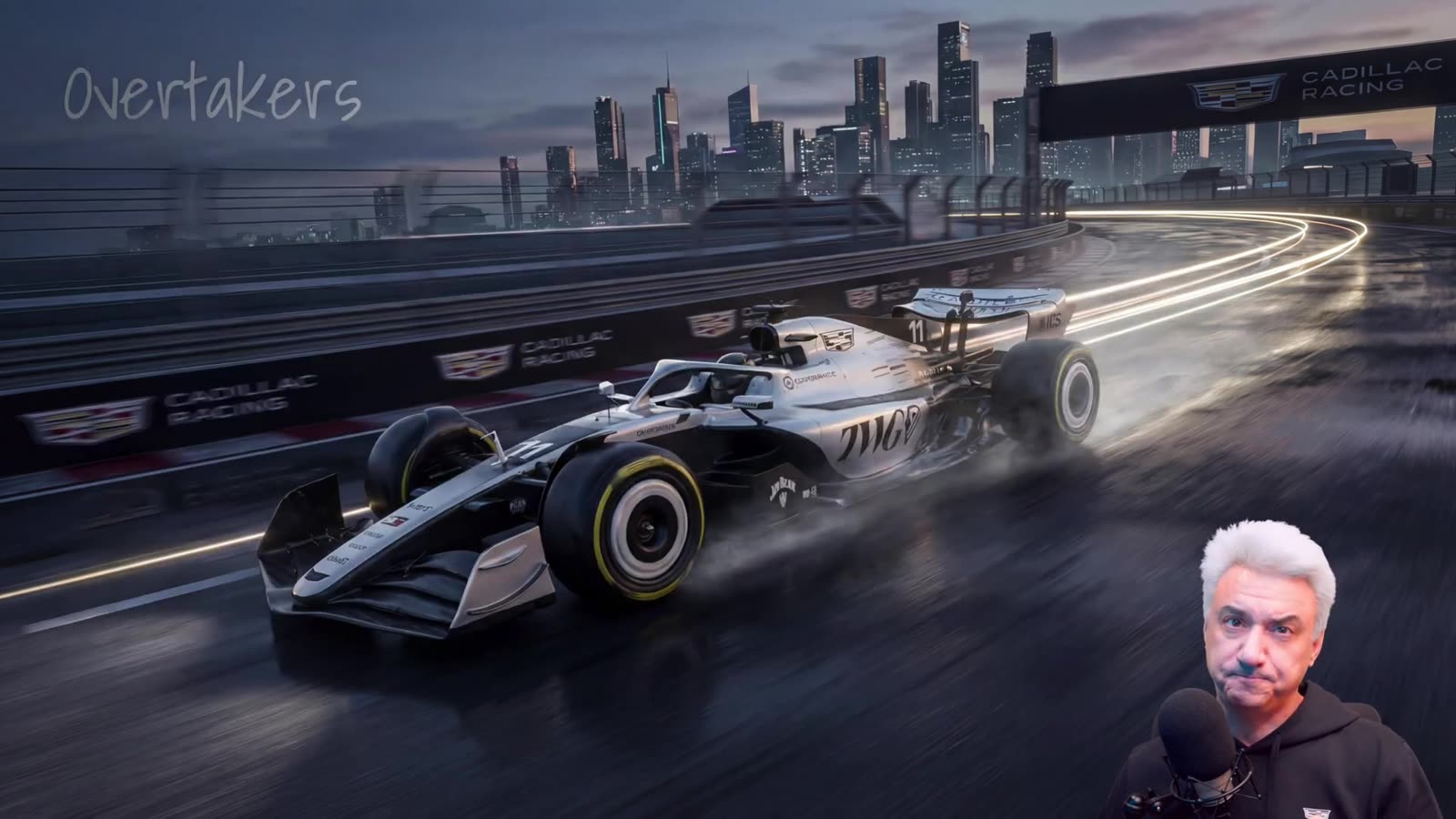
Inside the engine cylinder, the piston travels up and down. When the piston is at the bottom — Bottom Dead Centre — the cylinder has its maximum volume. As the piston rises to the top — Top Dead Centre — it squeezes that air into a much smaller space called the clearance volume. Compression ratio is simply total volume divided by clearance volume.
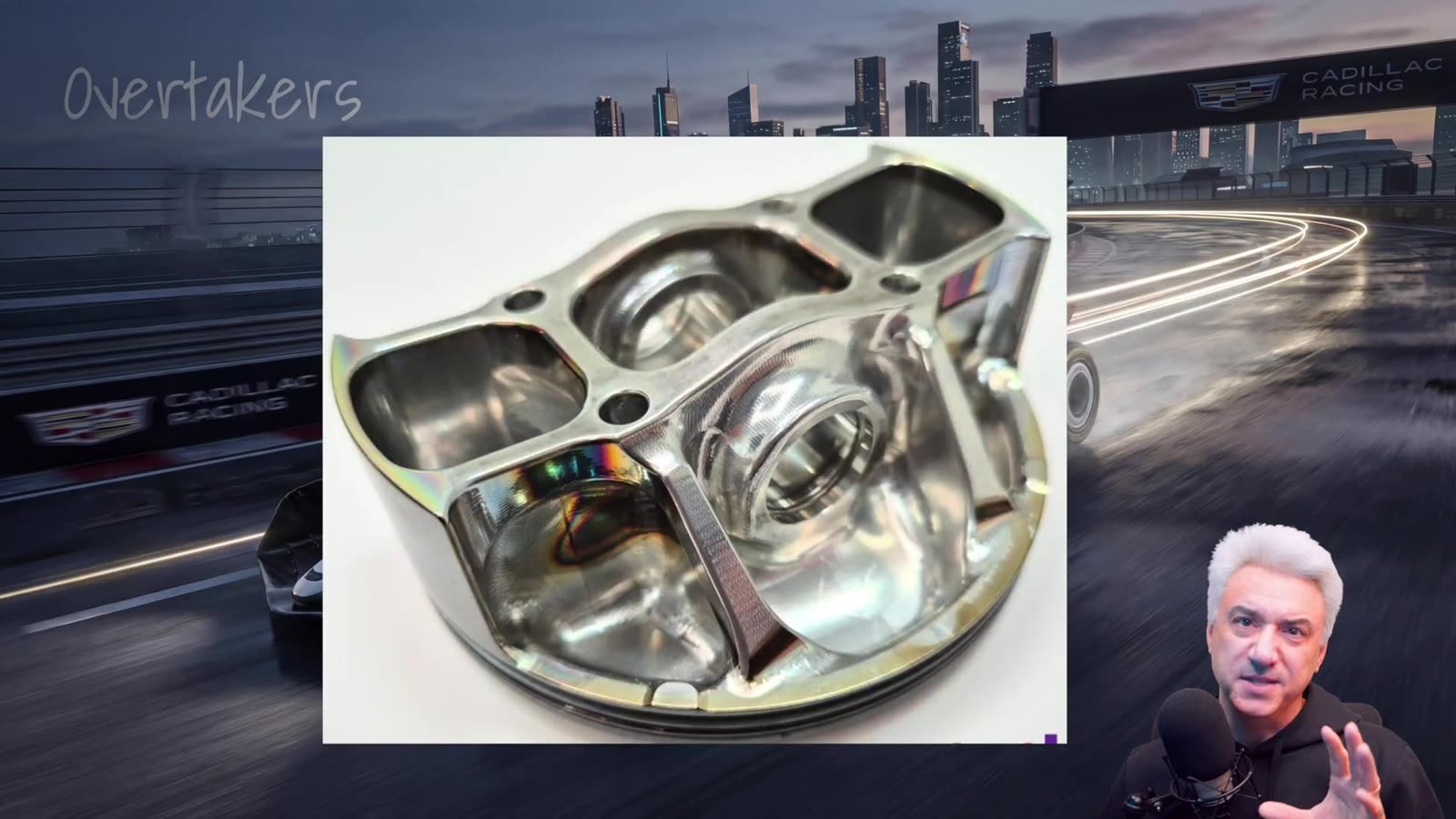
In F1 for 2026, the rules cap compression ratio at a maximum of 16:1.
But here's where it gets interesting
That 16:1 limit is only checked when the engine is cold — at ambient or room temperature, more precisely 25 °C / 77 °F. Mercedes is strongly suspected of having a design that measures at 16:1 cold but thermally expands to something closer to 18:1 once the engine reaches normal operating temperature.
Nobody outside the team knows the exact mechanism, but the leading theory is a special material or geometry on the cylinder head face or piston crown that deforms slightly as heat builds — physically closing the clearance volume from below.
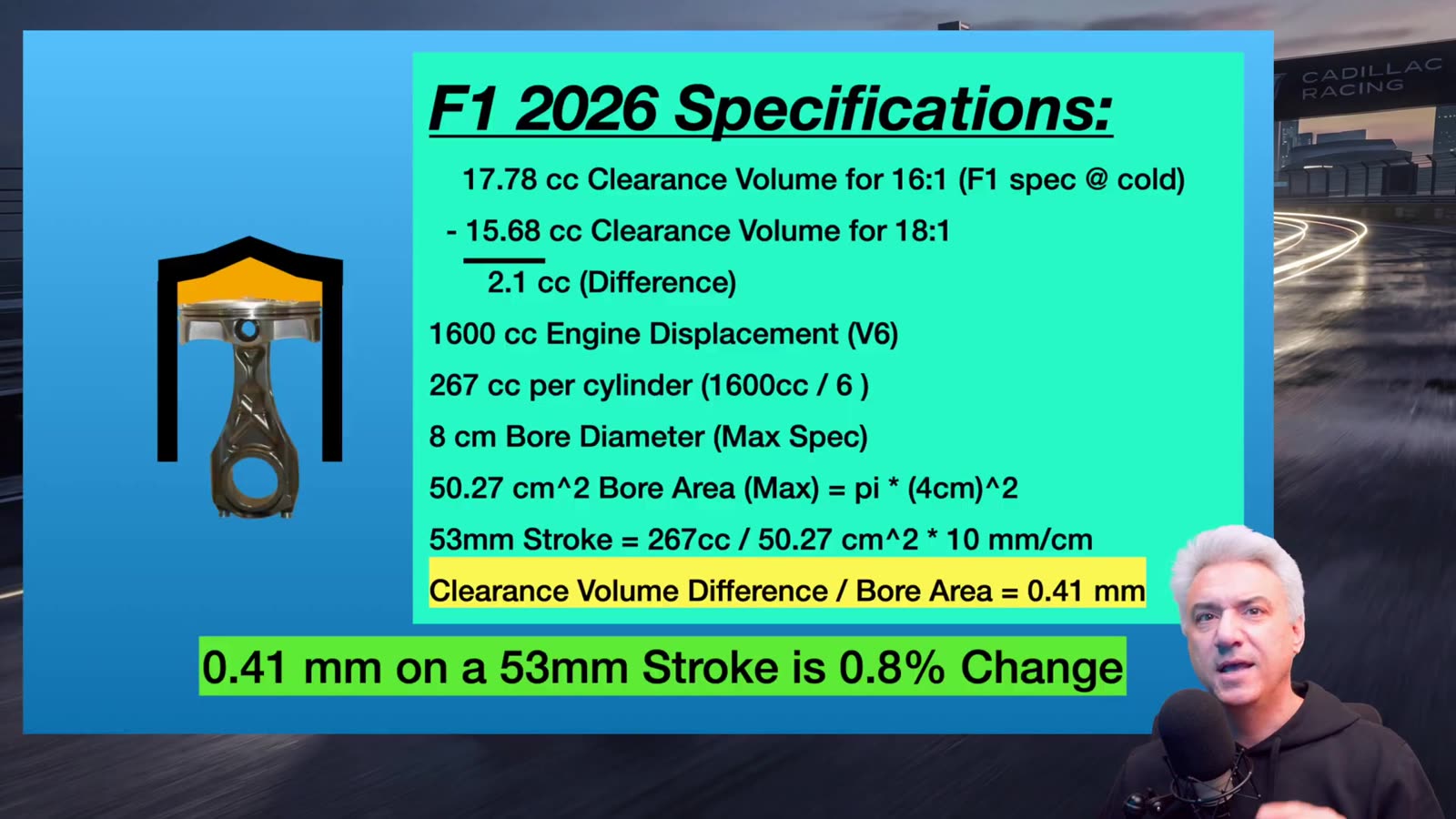
The numbers make this entirely plausible
Why does this matter? The pV diagram.
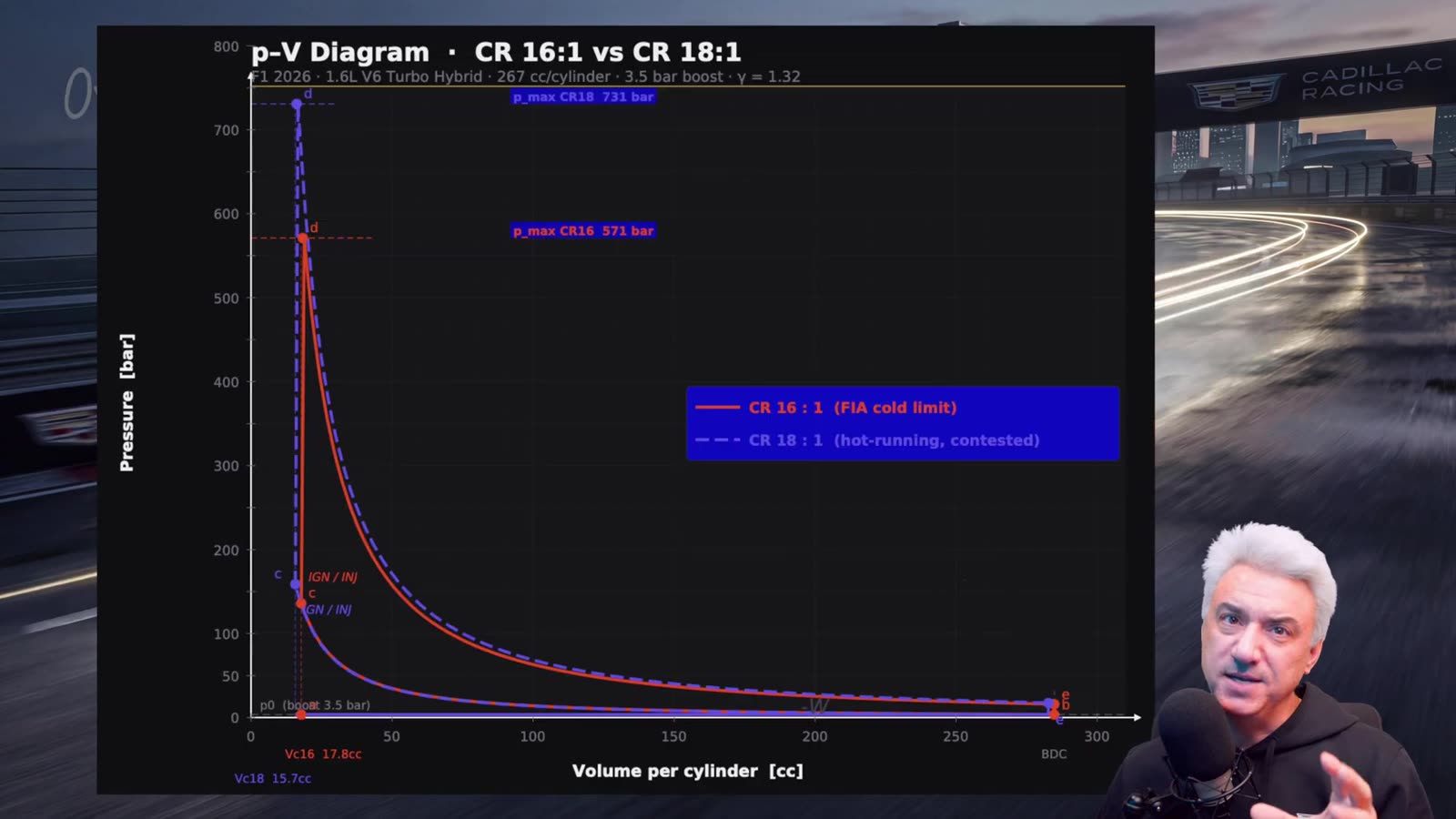
Both engines start at the same point with air compressed by the turbocharger at 3.5 bar. As the piston rises, both compress that air — but the 18:1 engine squeezes it harder, reaching 159 bar at the end of compression versus 136 bar for 16:1. That hotter, denser charge burns more completely. Fuel molecules sit in closer contact with oxygen, heat transfers more efficiently, and the result is a dramatically higher peak cylinder pressure — 731 bar for 18:1 versus 571 bar for 16:1.
That extra pressure is what pushes the piston harder on the power stroke. Same fuel, same air — significantly more useful work extracted.
Around 13 horsepower, worth roughly 0.3 to 0.4 seconds per lap.
On a power-sensitive circuit, that is a championship-level gap.
The FIA had to change the rule

The FIA initially ruled the Mercedes power unit fully legal — because the rules only specified a cold-temperature check, and there was no test procedure to measure compression ratio at operating temperature. It took a near-unanimous pushback from the other manufacturers to force a rule change.
04Advantage 2 — Real-Time Energy Strategy from HQ
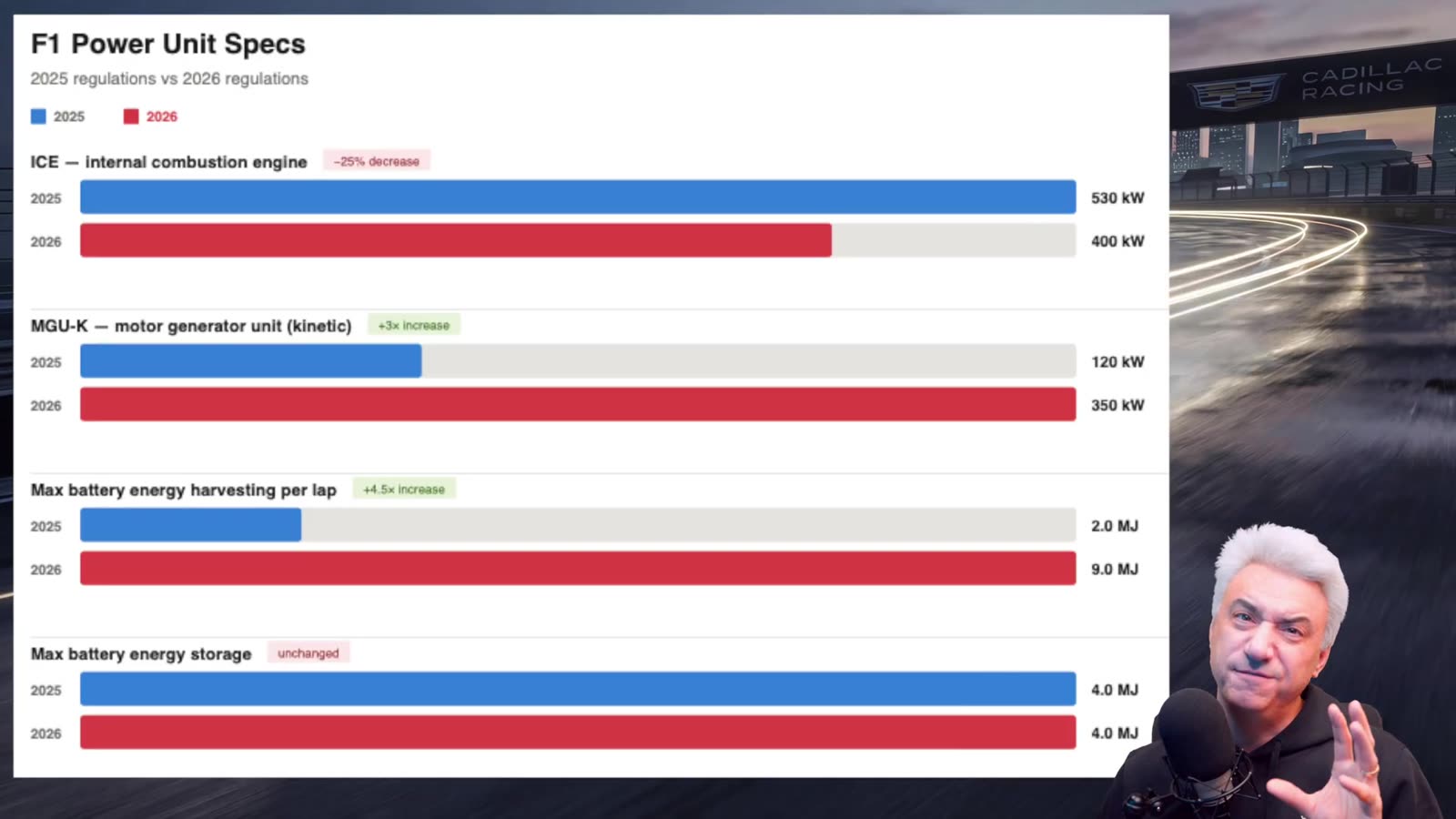
For 2026, the power-unit regulations have fundamentally changed how these cars generate speed.
The new power-unit math
- Combustion engine: reduced from 530 kW down to 400 kW.
- MGU-K (kinetic motor-generator): jumped from 120 kW to 350 kW — nearly a three-times increase.
- Energy harvesting budget per lap: grown from 2 MJ to up to 9 MJ.
The result is an almost exact 50-50 split between combustion and electric power — something Max Verstappen has compared to Formula E, and honestly, the numbers back him up.
So how is Mercedes finding an advantage here?
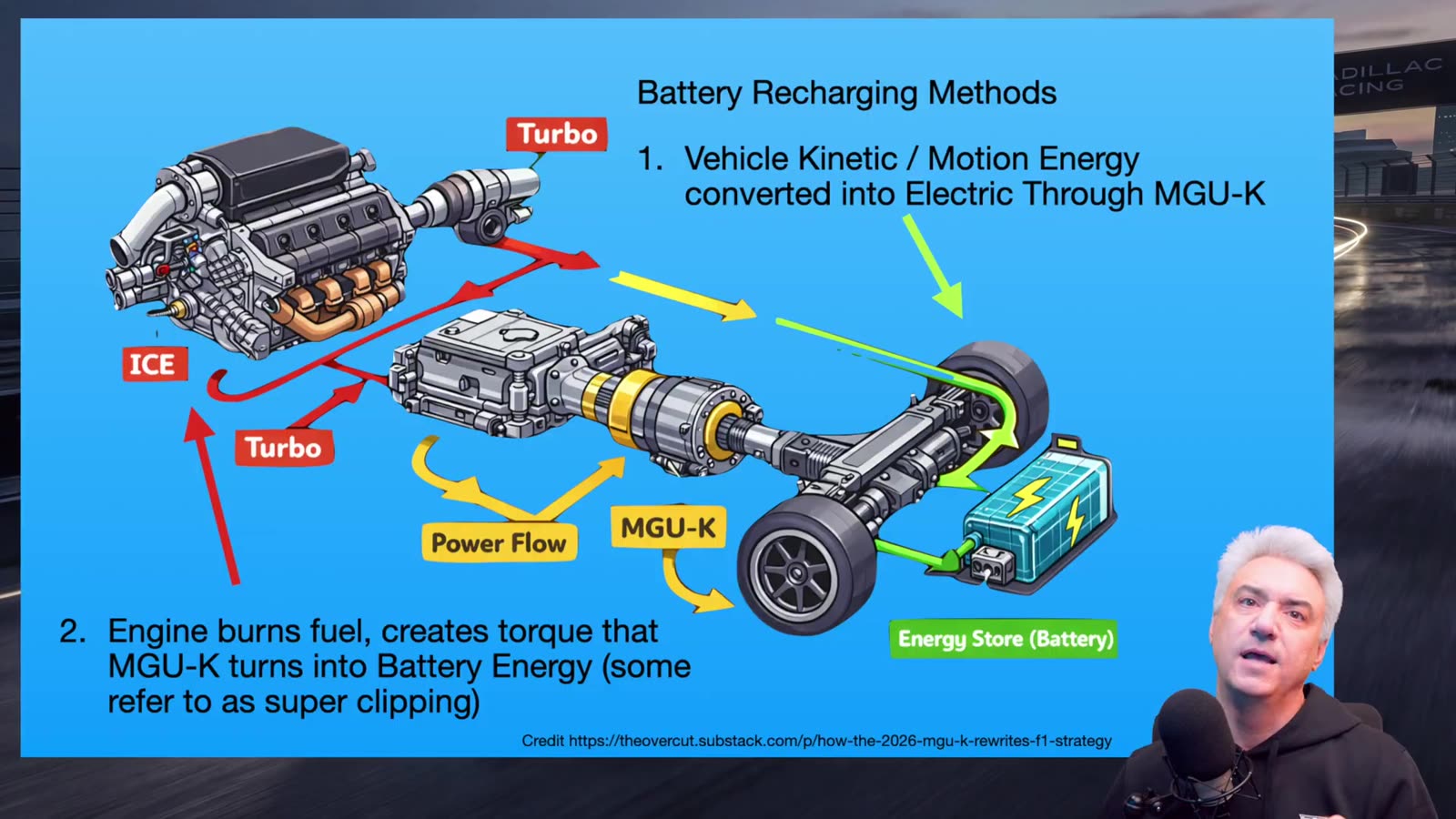
Once you've deployed that battery energy, you have to earn it back. There are essentially two ways to recharge:
- Regenerative braking — the MGU-K turns vehicle kinetic energy into electrical energy in the battery.
- Super-clipping — diverting combustion engine output into the MGU-K to charge on the straights.
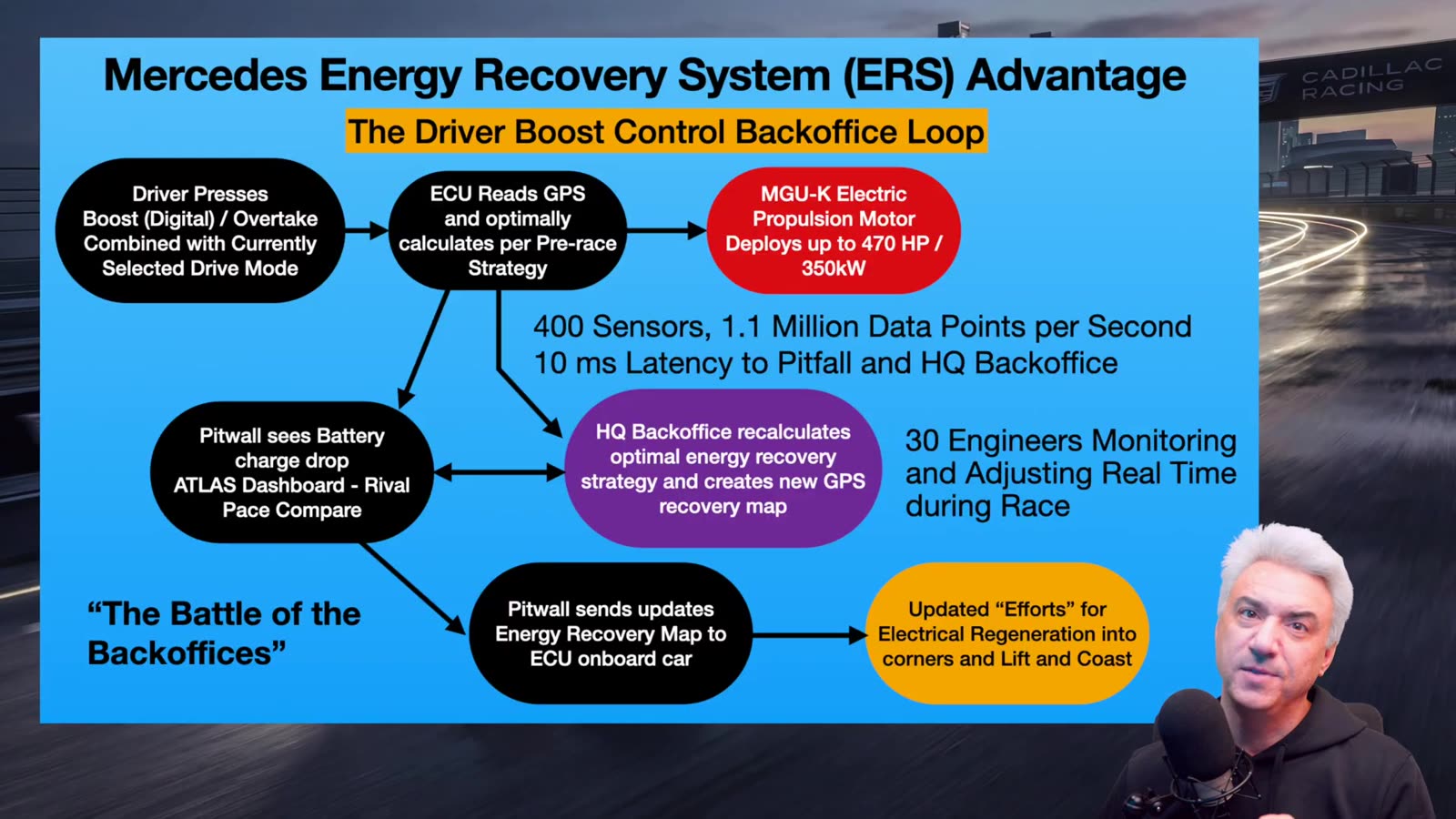
The when and how much of each strategy is where Mercedes is reportedly pulling ahead. Their drivers activate the boost — or in Verstappen's words, the "Mario Kart button" for overtaking — at the moments their engineers have identified as highest-impact.
Back at Mercedes HQ in Brackley, a room full of thirty engineers is watching over a million data points per second. Based on exactly when and how the driver uses their boost, they are rewriting the recharge maps in real time — adjusting the balance between regeneration, coasting, and engine charging — and transmitting those updates back to the car mid-race.
Mercedes has built it, polished it — and it's clearly working.
05Advantage 3 — Electric Drive Efficiency
The 2026 regulations limit electric power to 350 kW measured at what comes out of the battery. But to get that energy to the wheels, it has to go through:
- A DC-to-AC inverter at around 97% efficiency
- The electric motor itself at around 95% efficiency
Multiply those together and roughly 323 kW actually makes it to the drivetrain.
Now imagine your engineers find a way to improve that combined efficiency by just 1% — that's around 5 extra horsepower for free, without touching the combustion engine, without extra fuel, purely from reducing losses in the electrical chain. Mercedes is understood to have invested heavily in exactly this kind of marginal gain, and in a sport where 0.1 seconds separates front-runners from midfielders, a 5 horsepower electrical efficiency edge is absolutely meaningful.
06So Why Is Mercedes So Fast In 2026?
- One: a combustion engine that thermally expands to a higher compression ratio at operating temperature, extracting more power from the same fuel.
- Two: a real-time data operation that optimizes exactly when and how energy is deployed and recovered across every lap of every race.
- Three: an electrical drivetrain engineered to waste less of the energy it's given.
None of these are single silver bullets. Together, they're a compounding set of advantages across the entire power unit.
And that is exactly what separates great teams from the rest.
For the Cadillac team and others looking to close the gap — none of this is magic. It's engineering discipline, data investment, and a culture of chasing tenths.
07Looking Forward to Japan

To get ready, let's finish with Sergio doing that ninja thang.